Latest blogs from [Company name].
Children’s Homes: The New Financial Oversight Regime and a Possible Profit Cap
By Jitender Kaur ACA, ICAEW member, Fairfax Tax & Accounts | Published 21 October 2026
The Children’s Wellbeing and Schools Act 2026 became law on 29 April 2026. For owners of private children’s homes, two parts of it matter most:
- a new financial oversight scheme, run by the Department for Education (DfE)
- a power for the government to cap the profits private providers make from children’s placements
There has been a lot of worry about both. The short version: the oversight scheme is aimed at the largest providers, and no profit cap has been set. But the direction of travel is clear. Government wants to see providers’ finances, and the providers who will find this easiest are the ones whose accounts and structures are already clean.
This article explains what has actually been decided, what hasn’t, and what small and medium providers can sensibly do now.
The Financial Oversight Scheme: Who Is In Scope?
The scheme is designed to give the DfE early warning if a provider that would be hard to replace is heading for financial trouble. Its focus is the market’s biggest players, not the typical owner with one to five homes.
According to the government’s impact assessment:
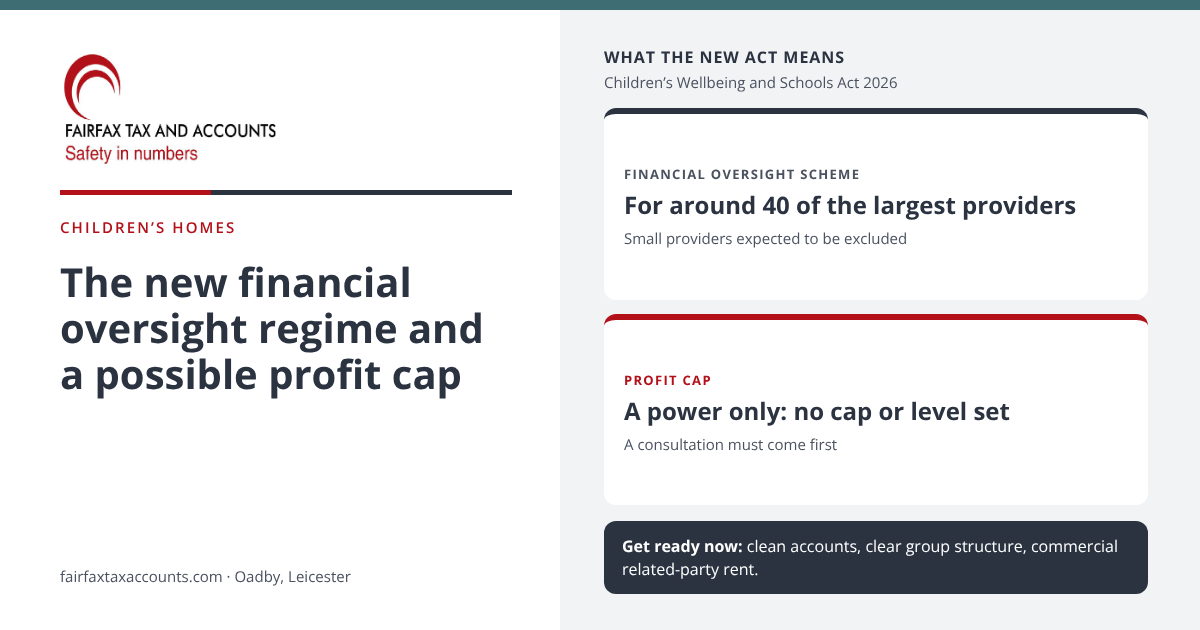
- around 40 providers are expected to be brought in, covering an estimated 42% of looked-after children’s placements
- providers are selected using four tests: the number of homes or agencies they run, their size, how concentrated they are in one area, and their market share
- small and micro providers are expected to be excluded, though some medium-sized providers could be caught where they have a large share of placements in one area
- the scheme covers children’s homes, supported accommodation and independent fostering agencies
What providers in the scheme will have to do
- Provide financial and business information, not just for the registered provider but for its parent companies and subsidiaries up to the top of the group
- Prepare a Recovery and Resolution Plan, showing cash reserves and how the business could wind down or hand over safely if it failed
- Tell the DfE about material changes, such as a worsening financial position
- Report as often as monthly or as rarely as annually, depending on their risk
The DfE can also commission an independent business review of a provider at risk, at the provider’s cost, and can issue penalties for failing to comply.
When does it start? On a date to be set in regulations. At the time of writing, no start date has been announced.
The Profit Cap: What Has and Hasn’t Been Decided
The Act gives the Secretary of State a power to cap the profits private providers make from children’s homes and independent fostering. It is not a cap itself. The position at October 2026:
- Is there a cap now? No.
- What level would it be? Not set. The government has deliberately avoided suggesting a figure.
- How would profit be measured? Not yet decided; this will be part of a consultation.
- Who would it cover? Private (non-local authority) children’s homes and independent fostering agencies; supported accommodation could follow.
- What has to happen first? The government must be satisfied a cap is needed for value for money, and must consult providers and councils.
- What would providers have to do? File an annual return, with penalties for breaches or late filing.
The government describes the cap as a “regulatory backstop”: something to use only if its other reforms don’t bring prices and profits down. Data gathered through the oversight scheme will feed into that decision.
The background is the Competition and Markets Authority’s 2022 study, which found the largest providers were earning operating margins of around 23% on children’s homes. That is the kind of figure driving the policy. It is not a proposed cap.
What Small and Medium Providers Should Do Now
Most owners won’t be in the oversight scheme, and no profit cap exists. But if a cap does come, every private children’s home would need to report its profit in a set format. Buyers, lenders and local authorities are already asking harder questions about finances. Getting ahead of that is sensible business practice anyway.
- Get your accounts up to date and consistent. Use the same accounting policies year to year, and keep management accounts that show each home’s results separately.
- Understand how “profit” could be measured. Directors’ pay, dividends, management charges and rent all affect reported profit. Any future rules are likely to look at how money leaves the business, not just the bottom line.
- Review related-party arrangements. If your homes are rented from your own property company, or a group company charges management fees, make sure these are on commercial terms and properly documented.
- Keep your group structure clear. The oversight scheme looks right up to the top of a group, so a tidy, documented structure is easier to explain.
- Track the key numbers. The DfE plans to benchmark providers on occupancy, profitability and agency staff costs. Knowing your own figures puts you in a stronger position with councils and buyers.
- Think about cash reserves. Providers in the scheme must show they can absorb losses. Smaller providers should plan for the same question from lenders and commissioners.
Operating in Wales? The Health and Social Care (Wales) Act 2025 goes further and phases out profit from children’s residential and foster care altogether, so Welsh operations need separate planning.
Frequently Asked Questions
Is there a profit cap on children’s homes?
Not yet. The Children’s Wellbeing and Schools Act 2026 gives the government the power to introduce one, but no cap or level has been set and a consultation must take place first.
Will my children’s home be in the financial oversight scheme?
Probably not if you are a small or micro provider. The scheme is expected to cover around 40 of the largest, hardest-to-replace providers. Some medium-sized providers with a large share of placements in one area could be included.
When does the financial oversight scheme start?
On a date to be set in regulations. No start date had been announced at October 2026.
Would a profit cap apply to small providers?
If introduced, it is expected to cover private children’s homes and independent fostering agencies generally, with providers filing an annual return. The government has said it will consider the extra burden on smaller firms in the consultation.
How Fairfax Tax & Accounts Can Help
We work with children’s home owners on accounts, management reporting, payroll and company structures. We can help you:
- produce clear year-end and management accounts, home by home
- review related-party rents, management charges and directors’ pay
- set up the KPIs commissioners and buyers ask about
- plan your group and property structure
Contact Fairfax Tax & Accounts on 0116 3677424.
Related reading: Sleep-ins, waking nights and the minimum wage and should the property sit in a separate company?
About the Author
Jitender Kaur ACA is a member of the Institute of Chartered Accountants in England and Wales (ICAEW) at Fairfax Tax & Accounts in Oadby, Leicester.
This article is general information based on the position at October 2026. It is not legal or tax advice for your situation.