
Latest blogs from [Company name].
Children’s Homes: Should the Property Sit in a Separate Company?
By Jitender Kaur ACA, ICAEW member, Fairfax Tax & Accounts | Published 21 October 2026
Many children’s home owners start with everything in one company: the care business and the buildings it operates from. As the business grows, a common question is whether the properties should sit in a separate company. Done well, it protects your property, helps with lending and gives you more options when you sell. Done badly, it can create tax bills and draw unwanted attention to how profit leaves the business.
How the Structure Works
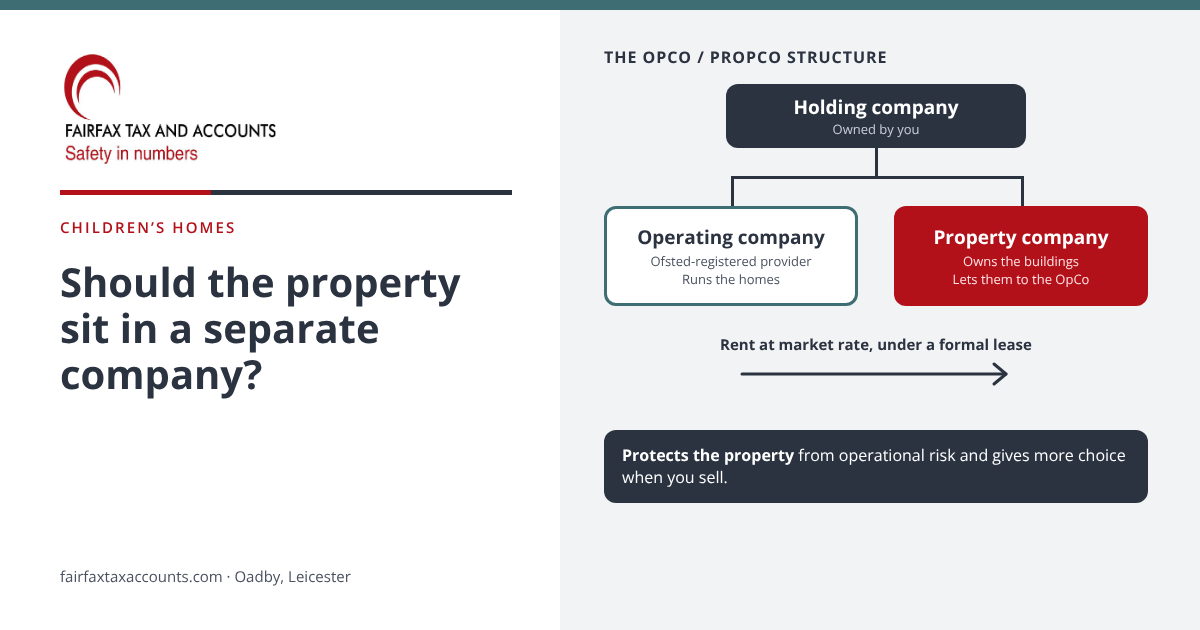
The usual set-up splits the business in two:
- The operating company (OpCo) is the Ofsted-registered provider. It employs the staff, cares for the children and receives the placement fees.
- The property company (PropCo) owns the buildings and lets them to the OpCo under a formal lease, at a commercial rent.
Both companies are often owned by a holding company that you own, which gives access to group tax reliefs. Some owners hold the PropCo personally instead. The right choice depends on your plans, so it’s worth modelling both.
Advantages of Holding the Property Separately
- Protects the property from operational risk. If a home has to close after an Ofsted decision, or the care business faces a claim or runs into financial difficulty, the buildings sit in a different company.
- Easier, cleaner borrowing. Lenders can lend to the PropCo against the property and a formal lease, assessing the rent the OpCo pays.
- More choice when you sell. You can sell the care business and keep the properties as a long-term investment that pays you rent, or sell them separately.
- Clearer financial picture. With the property costs separated out, the care business’s own performance is easier to see. Buyers and commissioners increasingly expect transparent finances.
- Succession planning. You can pass on the property and the care business separately, or bring investors into one without the other.
The Tax Points to Get Right
Rent must be commercial
The OpCo deducts the rent it pays, and the PropCo pays corporation tax on its rental profit. The rent should be what an unconnected landlord would charge, backed by a proper lease. A rent set too high to move profit out of the care business is exactly what HMRC, and the DfE under its new oversight powers, are likely to question.
VAT is usually a cost either way
Children’s home placement fees are exempt from VAT, so the OpCo can’t reclaim VAT on its costs. Rent from the PropCo is normally VAT-exempt too. A landlord can choose to charge VAT on commercial rent (“opting to tax”), but here that would usually just add VAT the OpCo can’t recover, and the option can be blocked where the tenant is connected and makes exempt supplies. Take advice before opting to tax.
Stamp duty when buying
Check which Stamp Duty Land Tax rates apply before you buy. A building already in use as a children’s home can be treated as non-residential for SDLT, which can mean lower rates and no 5% company surcharge. A normal house bought to convert is usually residential at the point of purchase.
Moving property you already own
Transferring a property from your existing care company into a new PropCo is treated as happening at market value. That can trigger corporation tax on any gain and SDLT. Group reliefs can often prevent both where the companies sit in the same group under a holding company, but the conditions are strict and the reliefs can be clawed back if the group changes within a few years.
When you sell
- Selling the OpCo on its own can qualify for Business Asset Disposal Relief on your shares (18% from April 2026), or, if a holding company sells it, the Substantial Shareholding Exemption, if the conditions are met.
- A PropCo that only holds and lets property is an investment company, so its shares won’t usually qualify for either relief.
- The split can also affect Business Relief for inheritance tax, so look at your estate planning before you restructure.
Disadvantages and Risks
- More companies, more cost. Each company needs its own accounts, tax return and confirmation statement, plus a formal lease between them.
- Restructuring can cost tax. Moving existing properties is a market value transaction, so check the reliefs before you start.
- Lenders and landlords. Existing mortgages and leases may need consent, and lenders often want guarantees between the companies.
- Shared corporation tax thresholds. Companies under common control split the £50,000 and £250,000 profit limits between them.
- Scrutiny of related-party rent. This is becoming more important. The Children’s Wellbeing and Schools Act 2026 gives the government powers to oversee providers’ finances, up to the top of their group, and to cap profits in future. Rent paid to an owner’s own property company is one of the ways profit can leave a care business, so expect it to be looked at. A documented, market-rate lease is your best protection.
Is a Separate Property Company Right for You?
It often suits you if:
- you own, or plan to buy, several properties
- you want to keep the properties if you ever sell the care business
- you want to protect the buildings from the risks of running the homes
- you’re raising finance and want clean security for lenders
It may not be worth it if:
- you run one home from a rented property
- moving existing property would trigger tax that reliefs can’t cover
- the extra running costs outweigh the benefits at your size
Frequently Asked Questions
Should my children’s home property be in a separate company?
It often makes sense once you own several properties or plan to sell the care business while keeping the buildings. It adds cost and must be set up carefully, so model the numbers first.
Do I charge VAT on rent to my own care company?
Usually not. Rent is normally VAT-exempt, and because children’s home fees are exempt the care company couldn’t reclaim VAT on the rent anyway.
Can I move my existing property into a new company without tax?
Sometimes. Transfers are treated as made at market value, but group reliefs can often prevent corporation tax and SDLT where both companies sit under the same holding company. The conditions are strict.
How much rent should my care company pay?
A commercial rent: what an unconnected landlord would charge for the same property, backed by a formal lease.
How Fairfax Tax & Accounts Can Help
We help children’s home owners plan and set up property and group structures, from modelling the tax and reliefs to drafting the steps with your solicitor, and then running the accounts for each company.
Contact Fairfax Tax & Accounts on 0116 3677424.
Related reading: Children’s homes: the new financial oversight regime and a possible profit cap
About the Author
Jitender Kaur ACA is a member of the Institute of Chartered Accountants in England and Wales (ICAEW) at Fairfax Tax & Accounts in Oadby, Leicester. Jitender advises children’s care home owners and other owner-managed businesses on accounts, tax and business structures.
This article is general information based on the rules at October 2026. It is not advice for your situation. Please take advice before restructuring.