Latest blogs from [Company name].
Sleep-ins, Waking Nights and the Minimum Wage: Payroll in Children’s Homes
By Jitender Kaur ACA, ICAEW member, Fairfax Tax & Accounts | Published 21 October 2026
Staff are the biggest cost in any children’s home, and night cover is where payroll most often goes wrong. Sleep-in shifts and waking nights are treated very differently for minimum wage purposes, and getting it wrong can mean years of back pay, penalties of up to 200% of the underpayment, and your company’s name on a government list.
In September 2026, the government named 658 employers for minimum wage breaches affecting more than 27,000 workers, with care and healthcare businesses among them. Most cases were down to technical payroll errors, not deliberate underpayment.
Minimum wage rates from 1 April 2026
- 21 and over (National Living Wage): £12.71 an hour
- 18 to 20: £10.85 an hour
- 16 to 17, and apprentices: £8.00 an hour
- Accommodation offset: £11.10 per day
Sleep-ins vs Waking Nights: What Counts as Working Time?
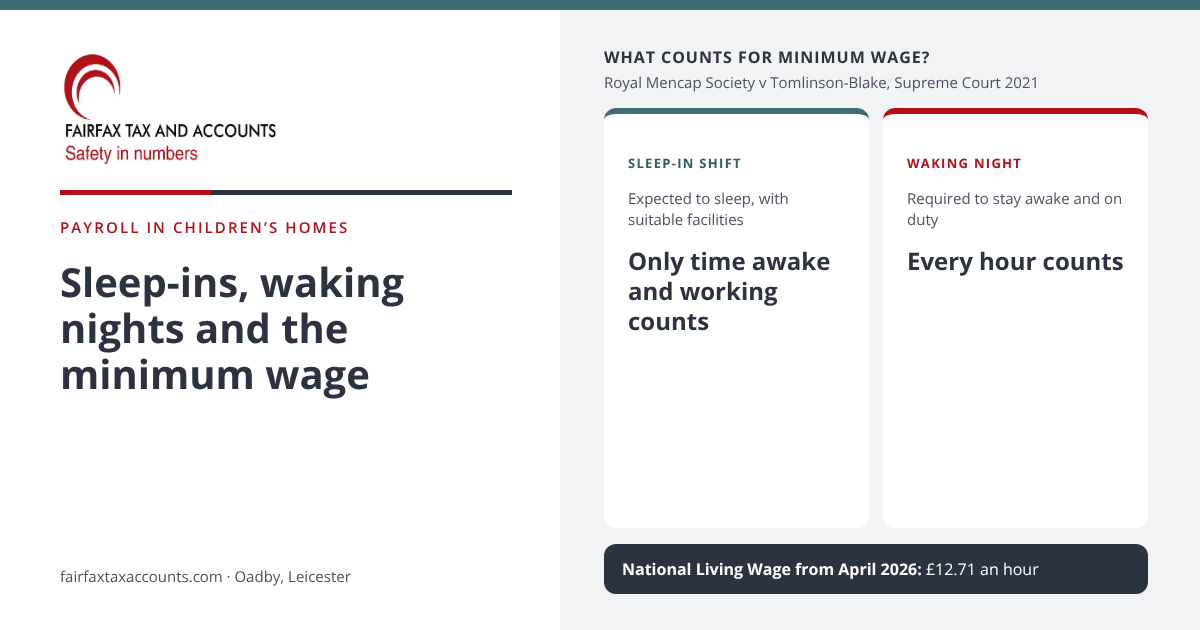
In 2021 the Supreme Court decided the leading case on this, Royal Mencap Society v Tomlinson-Blake. The rule that came out of it is:
- Sleep-in shifts: where a worker is expected to sleep and is given suitable facilities to do so, the time they are asleep, or simply available to be woken, does not count towards the minimum wage. Only the time they are awake for the purpose of working counts. A typical pay approach is a flat sleep-in allowance, plus hourly pay for any time woken to work.
- Waking nights: where a worker is required to stay awake and on duty, every hour counts and must be paid at least the minimum wage.
Where children’s homes get caught out
- The label doesn’t decide it. Calling a shift a “sleep-in” doesn’t help if, in practice, staff are expected to stay alert or are regularly up with young people. What matters is what actually happens.
- Time woken must be recorded. If staff are woken to deal with an incident, that time counts. Without records, it’s hard to prove you paid correctly.
- Frequent disturbances. In homes where night-time incidents are common, a sleep-in can turn into a waking night in all but name.
- The flat allowance isn’t a cushion. It doesn’t have to cover sleeping time at the hourly rate, but working time on top must be paid properly.
Keep shift patterns, rotas and incident logs consistent with how you pay, so you can show HMRC which hours were working time.
Other Minimum Wage Traps in Children’s Homes
Night shifts aren’t the only risk. These are the issues we see most often in care payroll:
- Unpaid handovers and training. Time spent at handover, in mandatory training or at team meetings is working time and must be paid.
- Deductions for work costs. Charging staff for DBS checks, uniforms or training, or deducting overpayments, can take their pay below the minimum wage for that pay period, even if the hourly rate looks fine.
- Salary sacrifice. Pension, childcare or car schemes that reduce pay can push lower-paid staff below the minimum. Sacrifice can’t take pay below the legal minimum.
- Long weeks for salaried staff. Managers and senior staff on a salary who work extra hours in a busy month can fall below the minimum when their pay is divided by the hours actually worked.
- Accommodation. If staff live on site, the most you can count towards the minimum wage for accommodation is the offset of £11.10 a day.
- Travel between homes. Time spent travelling between your homes during a working day counts as working time.
- Age and apprentice rates. Pay must rise on the right date when a worker moves into a higher age band, and apprentice rates only apply in specific circumstances.
The test is applied pay period by pay period. A worker who is paid correctly over the year can still be underpaid in one month.
What Happens If Staff Are Underpaid?
HMRC enforces the minimum wage and can investigate after a complaint or on its own initiative. If it finds underpayment:
- Back pay: you must pay workers what they are owed, calculated at today’s rate if that is higher than the rate when the work was done
- Penalty: up to 200% of the underpayment, capped at £20,000 per worker
- Naming: employers can be publicly named by the government
For a children’s home, public naming can be as damaging as the money. Local authorities, Ofsted and potential buyers all see these lists.
If you find a problem yourself, correct it and pay the arrears straight away. Putting things right before HMRC gets involved puts you in a much stronger position.
A Quick Payroll Checklist for Children’s Home Owners
- Contracts clearly say whether night shifts are sleep-ins or waking nights
- Rotas and incident logs match how night shifts are paid
- Time woken to work during sleep-ins is recorded and paid
- Handover, training and meeting time is paid
- Deductions and salary sacrifice don’t take anyone below the minimum
- Salaried staff’s hours are checked each pay period
- Pay rises are applied on 1 April and on birthdays that change age bands
Frequently Asked Questions
Do sleep-in shifts have to be paid at the minimum wage?
Not for the hours a worker is permitted to sleep, if suitable facilities are provided. Following the 2021 Supreme Court ruling in Royal Mencap Society v Tomlinson-Blake, only time spent awake for the purpose of working counts towards the minimum wage.
Do waking nights count for the minimum wage?
Yes. If staff are required to stay awake, every hour of the shift counts and must be paid at least the minimum wage.
What is the National Living Wage from April 2026?
£12.71 an hour for workers aged 21 and over. The rate for 18 to 20-year-olds is £10.85.
What is the penalty for underpaying the minimum wage?
Up to 200% of the underpayment, capped at £20,000 per worker, plus the arrears themselves. Employers can also be publicly named.
How Fairfax Tax & Accounts Can Help
We run payroll for children’s homes and other care businesses. We can review your shift patterns, contracts and pay for minimum wage risk, fix any problems before HMRC finds them, and keep your payroll compliant month to month.
Contact Fairfax Tax & Accounts on 0116 3677424, or see our payroll services.
Related reading: Children’s homes: the new financial oversight regime and a possible profit cap
About the Author
Jitender Kaur ACA is a member of the Institute of Chartered Accountants in England and Wales (ICAEW) at Fairfax Tax & Accounts in Oadby, Leicester. Jitender advises children’s care home owners and other employers on payroll, tax and accounts.
This article is general information based on the rules at October 2026. It is not legal or employment advice for your situation.
Sources
- Crossland Solicitors: National Minimum Wage and National Living Wage from April 2026
- Ross Martin: Penalties for National Minimum Wage
- The Employment Law Solicitors: Almost 660 employers named for minimum wage breaches (September 2026)
- Global Compliance News: Guidance on calculating minimum wage for sleep-in workers