
Latest blogs from [Company name].
Holding companies and property SPVs: is the structure right for you?
By Gurpaul Gawera, Director, Fairfax Tax and Accounts
If your company makes more profit than you need to take out, a holding company with a property SPV underneath can let you put that money into property without paying personal tax on it first. It suits some business owners well, but it isn't free to run and it isn't right for everyone. Here is how it works, what has changed for 2026/27, and the pros and cons.
How the structure works
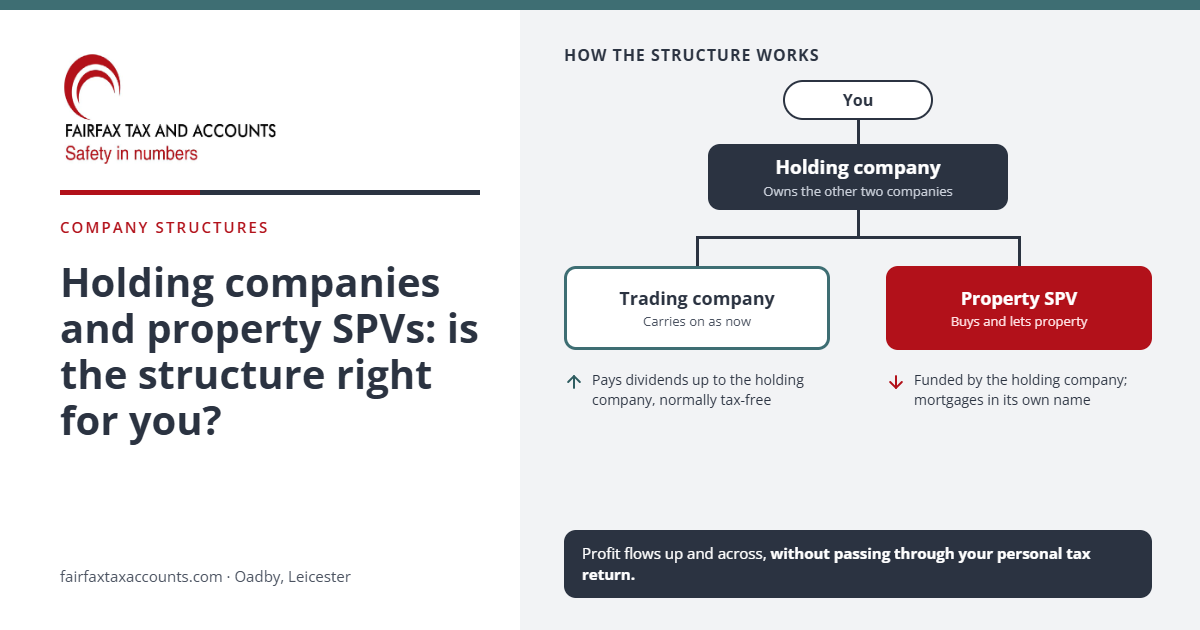
The set-up has three companies, all owned by you through one holding company:
- The holding company sits at the top. You own its shares, and it owns the other two companies. It doesn't trade.
- Your trading company carries on exactly as now. The only change is that its shares are owned by the holding company instead of you.
- The property SPV (special purpose vehicle) is a new company owned by the holding company. It buys and lets the property, and the mortgages sit in its name.
Profit flows up and across. Your trading company pays dividends to the holding company, which are normally tax-free between UK companies. The holding company then lends or invests that money into the SPV for deposits and purchases. None of it passes through your personal tax return on the way.
Getting there usually means a share-for-share exchange: you swap your shares in the trading company for shares in the new holding company. Done properly, there is no capital gains tax on the swap and no stamp duty.
What has changed since our last post
In our earlier article on SPVs and holding companies we looked at why more landlords are buying through limited companies. Since then, the November 2025 Budget has raised the tax on dividends from April 2026, and brings in separate, higher rates on rental profits from April 2027. Both make the case for keeping money inside a company stronger.
- Dividends (from 6 April 2026): basic rate 10.75% (was 8.75%), higher rate 35.75% (was 33.75%), additional rate 39.35% (no change).
- Rental profits held personally (from 6 April 2027): basic rate 22% (was 20%), higher rate 42% (was 40%), additional rate 47% (was 45%).
- Company profits (corporation tax, no change): 19% up to £50,000, 25% over £250,000, with marginal relief in between.
Personal landlords still only get tax relief on mortgage interest at the basic rate, which becomes 22% from April 2027. A company deducts its interest in full before corporation tax.
The flip side: taking money out of a company as dividends now costs more than it did, so the structure works best for money you intend to leave invested.
Advantages of a holding company and property SPV
- Invest company profits without personal tax first. Dividends from your trading company to the holding company are normally tax-free, so you're investing money taxed at 19–25% rather than after income tax as well.
- Full relief on mortgage interest. The SPV deducts all its finance costs, unlike a personal landlord, who only gets basic-rate relief.
- Property kept apart from trading risk. If the trading business hits trouble, the property sits in a separate company, and the reverse is true too.
- Protects your trading company's tax status. Holding lots of cash or investment property inside a trading company can cost it its "trading" status. That can affect Business Asset Disposal Relief when you sell, and Business Relief for inheritance tax.
- Lender-friendly. Most buy-to-let lenders want a dedicated property company with property SIC codes, which is exactly what an SPV is.
- A cleaner future sale. If the holding company sells the trading company, the gain can be tax-free under the Substantial Shareholding Exemption, provided the conditions are met.
- Room to grow. New ventures or further SPVs can sit under the same holding company, each with its own risk.
Disadvantages and costs to weigh up
- More companies, more cost. Each company needs its own accounts, corporation tax return and confirmation statement. Three companies cost more to run than one.
- Money is harder to get out. Profits in the group are taxed again as dividends when you take them personally, now at 10.75% or 35.75%. If you need the rental income to live on, owning personally may still work out cheaper.
- Shared corporation tax thresholds. Companies under common control are "associated", so the £50,000 and £250,000 limits are split between them. With three companies, more profit can fall into the marginal rate band.
- Company mortgages cost more. There are fewer products, rates and fees are often higher, and lenders usually want a personal guarantee from you.
- Higher stamp duty on residential purchases. Companies always pay the 5% surcharge on residential property, and a flat 17% applies above £500,000 unless the property is let commercially.
- Moving property you already own is expensive. Transferring personal property into a company is treated as a sale at market value, which can trigger capital gains tax and stamp duty. The structure works best for new purchases.
- Set-up takes time. HMRC clearance on the share exchange normally takes around 30 days, and the paperwork has to be right first time.
Things people often miss when setting up a holding company
- Get HMRC clearance before the share exchange. We apply under section 138 TCGA 1992 and section 701 ITA 2007 so HMRC confirms there is no capital gains or income tax charge on the swap. Since November 2025 the test is whether a main purpose is to reduce or avoid capital gains tax, so the commercial reasons need setting out clearly.
- Mirror the share classes exactly. Stamp duty relief on the share exchange only applies if the holding company's shares match the trading company's. Get this wrong and you pay 0.5% of the company's value.
- Think about the names early. A holding company called "[Name] Holdings Ltd" may count as the same name as your existing company at Companies House. It's allowed, but the existing company has to give its consent.
- Line up the year ends. Matching accounting dates across the group keeps the accounts and tax returns simpler.
- Don't treat the trading company as a bank. Lending money to yourself, or paying for property directly from the trading company, can create a tax charge on director's loans and muddy the trading status you're trying to protect.
- Directors need verified ID. Every director now needs a Companies House personal code before a new company can be formed.
Is a holding company and SPV right for you?
It usually suits you if:
- your company makes more profit than you need to take out each year
- you plan to buy property and leave the rental income invested for the long term
- you're a higher or additional rate taxpayer
- you want to keep property separate from the risks of your trading business
It's usually not worth it if:
- you need the rental income to live on now
- you're buying one property and have no plans to grow
- you want to move property you already own personally into the company
- your company's profits are small, so the running costs would eat the saving
Frequently asked questions
What is a property SPV? A special purpose vehicle is a limited company set up only to buy, hold and let property. Lenders prefer them because the company does nothing else.
Do I pay tax when my trading company sends money to the holding company? Dividends between UK companies in the same group are normally exempt from corporation tax.
Is there capital gains tax on moving my shares into a holding company? Not if the share-for-share exchange qualifies and HMRC gives clearance. Any gain is deferred until you sell.
How long does the restructure take? Typically six to eight weeks, mostly waiting for HMRC clearance.
Talk to us
Every business is different, and the numbers decide whether this structure pays for itself. At Fairfax Tax and Accounts in Oadby, Leicester, we set up holding company and SPV structures from start to finish: HMRC clearance, the share exchange, stamp duty and the Companies House filings. Get in touch and we'll model it on your own figures.
About the author
Gurpaul (Gurps) Gawera is a director of Fairfax Tax and Accounts in Oadby, Leicester. He advises business owners on company restructures, holding company set-ups, tax and compliance, and has an extensive property portfolio of his own, so he knows the landlord side of these decisions first-hand.
This article is general information based on the rules at October 2026. It isn't advice for your situation, so please speak to us before acting on it.