Latest blogs from [Company name].
HMRC Letters to Medical Consultants: What to Do If You Receive One
By Jitender Kaur ACA, ICAEW member Published 16 October 2026
HMRC has started writing to medical consultants about their private income. The letters say HMRC has received information from private healthcare providers suggesting the recipient may have been paid consultancy fees, and asks them to check that every pound has been declared on their Self Assessment returns.
If one has landed on your doormat, don’t panic and don’t ignore it. The letter itself says it isn’t a compliance check, and you have 30 days to respond. How you respond in that window can make a real difference to the outcome.
This guide covers:
- What the letter says and why HMRC is sending it
- Who is likely to receive one
- What to do in the 30 days after it arrives
- What happens if some income was missed
- The most common reasons private medical income goes undeclared
What Is the HMRC Letter About?
The letter is part of what HMRC calls a “one-to-many” campaign. Rather than opening formal enquiries, HMRC writes to a group of people it thinks may have under-declared a particular type of income, and invites them to check and correct their own tax returns.
This campaign was reported by the ICAEW in late September 2026 and focuses on consultants in the medical sector. The letter says:
- HMRC has received information from private healthcare providers indicating you may have received consultancy fees
- It wants you to check those fees are fully declared on your Self Assessment returns
- You should respond within 30 days of the date on the letter
- “This isn’t a compliance check at this stage”
The letter is sent to you personally, and HMRC notes that your accountant has not been sent a copy. Pass it on to your adviser as soon as it arrives.
Who Is Likely to Receive One?
The letters are going to consultants whose private healthcare income, as reported to HMRC by private hospitals and clinics, doesn’t appear to match what is on their tax returns. That typically includes:
- NHS consultants who also see private patients
- Consultants who have moved into fully private practice
- Surgeons, anaesthetists and radiologists billing private hospitals or insurers
- Doctors providing medico-legal reports or other consultancy work alongside clinical practice
HMRC can obtain information from third parties such as private healthcare providers, and it matches that data against Self Assessment returns. A letter does not mean you have done anything wrong. It means HMRC’s data and your returns don’t obviously line up, and it wants you to check.
What to Do If You Receive a Letter
- Note the date on the letter. Your 30 days run from that date, not from when you opened it.
- Check it’s genuine. HMRC publishes a list of genuine contacts on GOV.UK. Scam letters and emails often copy HMRC campaigns.
- Send it to your accountant straight away. HMRC hasn’t sent them a copy.
- Gather your figures. Collect statements and remittances from every private hospital, clinic and insurer you’ve billed, and compare them year by year with what went on your returns.
- Work out where the income was taxed. If your private work is billed through your own limited company or a partnership, the fees belong in those accounts, not your personal return. That is a common reason for an apparent mismatch.
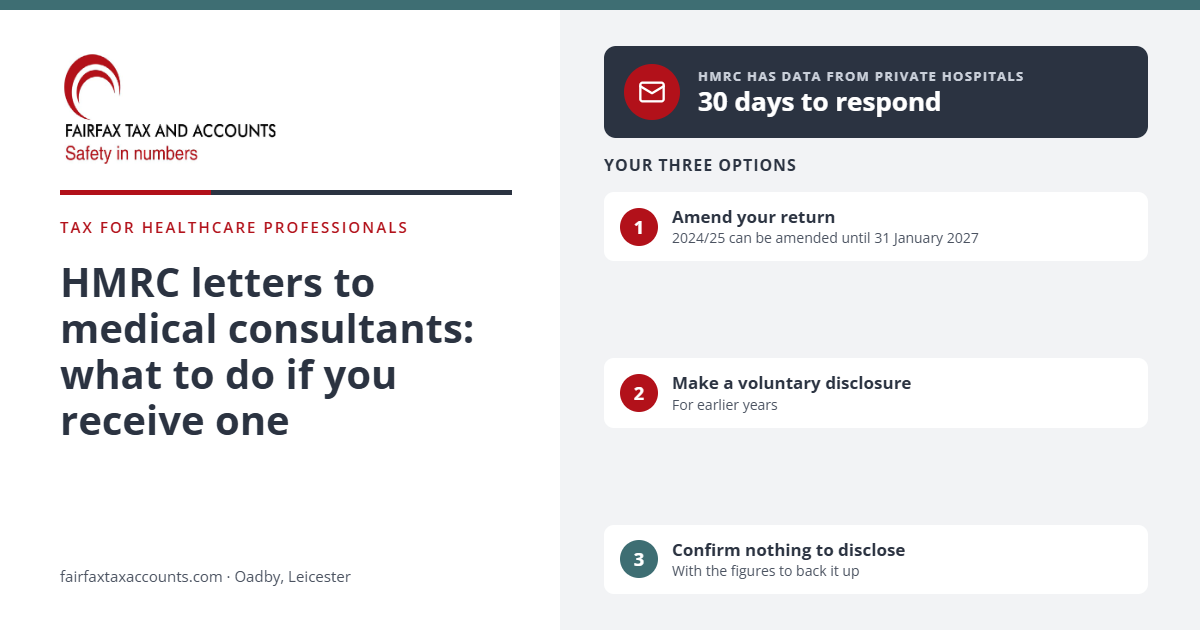
- Respond before the deadline. HMRC asks you to amend your return if the error is in a year where the amendment window is still open, make a voluntary disclosure for earlier years, or tell HMRC you have nothing to disclose, and why.
Which years can still be amended? You can normally amend a return within 12 months of its filing deadline. As at October 2026, that means the 2024/25 return can be amended until 31 January 2027. For 2023/24 and earlier years, corrections go through HMRC’s voluntary disclosure process instead.
Don’t simply ignore the letter. HMRC says that if you don’t respond, it will keep monitoring your records and may make decisions based on the information it holds. That can lead to a compliance check and penalties.
What If Some Income Was Missed?
If private fees were left off a return, you’ll owe the tax, interest for late payment, and potentially a penalty. The penalty depends on two things: why the error happened, and whether you told HMRC before it found out.
HMRC’s letter says that if errors are later found in your returns, any disclosure about consultancy fees will be treated as prompted. Prompted disclosures attract higher minimum penalties than unprompted ones. Penalties are a percentage of the extra tax due (rates shown are for UK income):
- Careless (a genuine mistake, but reasonable care not taken): 0% to 30% if unprompted, 15% to 30% if prompted
- Deliberate: 20% to 70% if unprompted, 35% to 70% if prompted
- Deliberate and concealed: 30% to 100% if unprompted, 50% to 100% if prompted
Within each range, the penalty falls the more you help: telling HMRC, helping it work out the figures, and giving access to records. HMRC’s letter makes the same point, saying penalties can be reduced by acting promptly, being open about mistakes and putting things right.
How far back can HMRC go?
- 4 years for a genuine mistake where reasonable care was taken
- 6 years where the error was careless
- 20 years where it was deliberate
That is why the reason for any missed income matters, and why it’s worth getting the explanation and the numbers right before responding.
Common Reasons Private Medical Income Gets Missed
In our experience, under-declared private income is rarely deliberate. More often it comes from how the income is paid:
- Fees are paid gross. Private hospitals and insurers don’t deduct tax, unlike NHS pay through PAYE. It’s easy to assume tax has been taken care of.
- Several payers. Income can come from hospitals, insurers, self-pay patients, medical secretaries’ billing services and medico-legal agencies. One stream gets overlooked.
- Company or personal? Some fees go to a limited company and some to you personally. Each must be declared in the right place.
- Partnership or group practice income. Your share is taxed through the partnership return and must also appear on your own return.
- Timing. Fees invoiced in one tax year but paid in the next can fall between returns.
- Medico-legal and ad hoc work. Expert witness reports, insurance assessments and teaching fees are often treated as “one-offs” and missed.
It can work the other way too. If HMRC’s data includes fees that were correctly taxed in your company, your response simply needs to explain that, with the figures to back it up.
Frequently Asked Questions
Is an HMRC letter about consultancy fees an investigation?
No. HMRC’s letter states that it isn’t a compliance check at this stage. It is an invitation to check your returns and correct any errors yourself. Ignoring it, however, can lead to a compliance check.
How long do I have to respond?
HMRC asks for a response within 30 days of the date on the letter.
What if all my private income has already been declared?
Tell HMRC that you have nothing to disclose. It’s sensible to have your accountant check the figures first, especially if some fees are paid to a limited company or partnership.
Can I still amend my tax return?
You can normally amend a return within 12 months of its filing deadline. The 2024/25 return can be amended until 31 January 2027. Earlier years are corrected through HMRC’s voluntary disclosure process.
Will I have to pay a penalty?
It depends on why the income was missed and how you respond. Penalties for careless errors can be reduced to 15% of the extra tax where HMRC has prompted the disclosure, and there is no penalty if you took reasonable care.
Does my private practice income go on my personal tax return?
Only if the fees are paid to you personally. Fees paid to your limited company are taxed in the company, and partnership income is declared through the partnership return and your own return.
Received a Letter? Speak to Us Before You Reply
At Fairfax Tax & Accounts, we work with consultants, GPs, dentists and other healthcare professionals on their private practice income, limited companies and Self Assessment. If you’ve received one of HMRC’s letters, we can:
- reconcile your private income against your returns, year by year
- work out whether anything is actually owed, and why any gap arose
- prepare return amendments or a voluntary disclosure to HMRC
- deal with HMRC on your behalf and keep penalties as low as possible
The 30-day window is short, so get in touch as soon as the letter arrives. Contact Fairfax Tax & Accounts on 0116 3677424.
Related reading: Doctor moving abroad? The UK tax questions to consider before you go
About the Author
Jitender Kaur ACA is a member of the Institute of Chartered Accountants in England and Wales (ICAEW) at Fairfax Tax & Accounts in Oadby, Leicester. Jitender advises doctors, healthcare professionals and owner-managed businesses on UK tax, private practice income and dealing with HMRC.
This article is general information based on HMRC’s letter and the rules at October 2026. It is not advice for your situation. Please speak to us before responding to HMRC.