Latest blogs from [Company name].
Founders’ Relief: Who Qualifies, What Experts Say, and the Dos and Don’ts
By Jitender Kaur ACA, ICAEW member, Fairfax Tax & Accounts | Published 5 November 2026
When I first heard that the Chancellor had announced something as fancy-sounding as Founders’ Relief, I got excited. I thought the UK had finally made its long-overdue U-turn and was getting serious about backing businesses and bringing back growth. Then I read the small print.
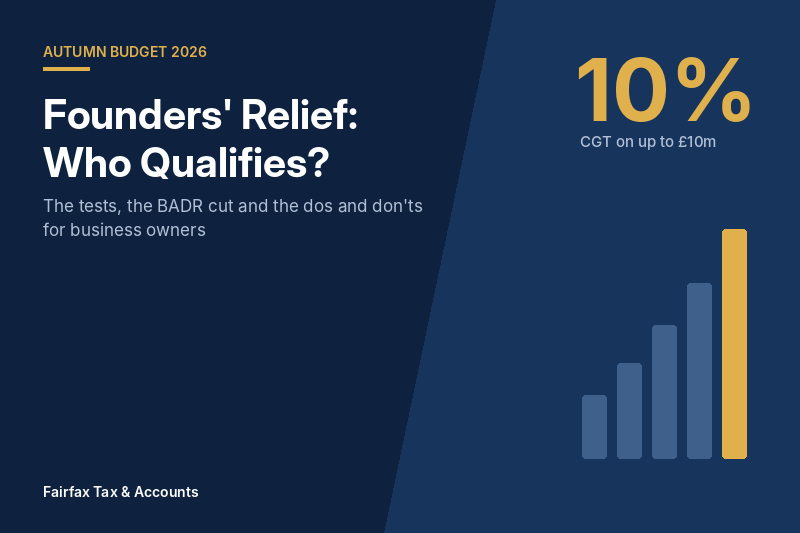
Founders’ Relief offers a 10% capital gains tax rate on up to £10 million of lifetime gains. But only a small number of fast-growing companies are expected to qualify, and at the same Budget the Chancellor halved the limit for Business Asset Disposal Relief. This article sets out what the relief is, who can claim it, what economists and advisers are saying, and the practical dos and don’ts for business owners thinking about a sale.
What Is Founders’ Relief?
Founders’ Relief is a proposed new capital gains tax (CGT) relief announced in the Autumn Budget on 28 October 2026. It is not yet law.
- CGT rate: 10%, against 24% for higher-rate taxpayers with no relief
- Lifetime limit: £10 million of gains per individual
- Start date: qualifying share disposals on or after 6 April 2027
- Who can claim: individuals only, meaning founders and significant early investors
- Interaction with other reliefs: BADR and Investors’ Relief claimed from 6 April 2027 reduce the £10m limit
- Status: technical consultation closes 30 November 2026, with legislation in Finance Bill 2026-27
The government expects around 600 shareholders in 400 businesses to claim each year. That is a very small slice of UK business owners.
Who Qualifies?
You must pass every founder test and every company test, plus at least two of the three growth and innovation tests.
Founder tests (all required)
- Founding stake: at least 25% of the ordinary shares, with matching voting and economic rights, when the trade (or preparation for it) began
- Holding period: shares held for at least five years before the sale
- Residence: UK resident under the Statutory Residence Test for five consecutive tax years before the sale
Because each founder needs 25% at the start, a company can have at most four qualifying founders. Later dilution below 25% does not count against you.
Company tests (all required)
- Tax status: within UK corporation tax, with a substantial UK presence for the five accounting periods before the sale
- Trading: a trading company (or holding company of a trading group) without substantial non-trading or excluded activities
- Same trade: still carrying on the trade it was founded for
- Turnover: at least £10m in the accounting period before the sale
- Staff: at least 15 qualifying full-time employees in that period, working 35+ hours a week and paid at least the National Minimum Wage. Directors, contractors and agency staff don’t count.
Growth and innovation tests (any two of three)
- Turnover growth: average compound growth of 25% a year over three consecutive accounting periods within the ten years before the sale, from a starting turnover of at least £10m
- Headcount growth: average compound growth of 25% a year in qualifying full-time employees over three consecutive periods in the same ten-year window, from at least 15
- Innovation (R&D): at least £1.5m of qualifying R&D spend, with R&D tax relief claimed, for accounting periods ending in the three years before the sale
25% compound growth over three years means roughly doubling, for example turnover rising from £10m to about £19.5m, or staff from 15 to around 30.
R&D is not compulsory. A company that doesn’t claim R&D relief can still qualify by passing both the turnover and headcount tests. But if you rely on R&D and HMRC later rejects the claim, you could lose the relief and owe the extra CGT.
Is My Sector Excluded?
No sector is named in the consultation. Instead, Founders’ Relief borrows the excluded-activities list from the Enterprise Investment Scheme (EIS), set out in section 192 of the Income Tax Act 2007. If your trade is not on the list, it can qualify. The main excluded activities are:
- dealing in land, commodities, shares or other financial instruments
- dealing in goods outside an ordinary wholesale or retail trade
- banking, insurance, money-lending and other financial activities
- leasing, and receiving royalties or licence fees (self-created IP is carved out)
- legal or accountancy services
- property development
- farming, market gardening and forestry
- shipbuilding, coal production and steel production
- running hotels, nursing homes or residential care homes
- energy generation and fuel production
A small amount of excluded activity is allowed. HMRC normally treats it as not substantial if it is no more than 20% of the trade, measured by turnover, capital employed or another reasonable measure.
Example: construction and groundworks. An excavation contractor is not excluded. Watch for side activities that are: dry hire of plant without an operator may count as leasing, and buying, preparing and selling plots may count as property development or land dealing.
One open question: the consultation does not define “substantial UK presence”, and it is not an established term elsewhere in UK tax law.
The Catch: BADR Is Being Cut
At the same Budget, the lifetime limit for Business Asset Disposal Relief (BADR) was halved from £1 million to £500,000 from 6 April 2027. For most owners, this matters more than Founders’ Relief.
- Founders’ Relief (proposed): 10% on up to £10m, for fast-growing companies with £10m+ turnover
- BADR from 6 April 2027: 18% on up to £500,000 (was £1m), for most qualifying trading-business owners
- No relief: 24%
On a £1m gain, BADR today gives a £180,000 tax bill. From April 2027, only the first £500,000 gets 18%; the rest is taxed at 24%, making £210,000.
What People Are Saying
The first reaction was positive. Within days, the mood had turned sceptical.
The welcome. Founders Forum co-founder Brent Hoberman said entrepreneurs would breathe a sigh of relief. Honest Mobile chief executive Andy Aitken said that, after years of going backwards, government had finally recognised the need to reward founders.
Economists
- Helen Miller, Director, Institute for Fiscal Studies (IFS). She said the more she looked at the detail, the more “bonkers” it seemed. The IFS argues the relief gives a lower tax rate to a small group with large gains, much of whose activity would have happened anyway, and that the complex rules will push people to change behaviour in odd ways. In a Financial Times article she suggested the scheme may one day be renamed “Flawed Relief”.
- Paul Johnson, former IFS Director, publicly agreed, and the IPPR think tank was also sceptical.
- The cost. The Treasury expects the relief to cost £1.3 billion in total from 2027/28 to 2031/32.
Big Four accountancy firms
- PwC. Will Dowsett, UK private business tax leader, welcomed the incentive but called the criteria onerous, with ownership, turnover, staff, growth and R&D conditions all adding complexity.
- KPMG. Sharon Baynham described the relief as the Budget’s surprise “rabbit out of the hat”. KPMG puts the maximum benefit at £1.4m per person and advises founders to review historic ownership, residence, trading, turnover, headcount and R&D records now.
- EY. Chris Sanger, UK tax policy leader, said the real test is whether serial entrepreneurs stay in the UK and reinvest.
Banks and wealth managers
- Rathbones. Ed Wood, Financial Planning Director, said the relief is designed for high-growth businesses and some founders will be disappointed to find they don’t qualify. He also pointed out that halving the BADR limit cuts its maximum benefit from £60,000 to £30,000 per person.
Professional bodies and founders
- ICAEW compares the government’s estimate of around 600 Founders’ Relief claimants a year with roughly 61,000 people who claimed BADR or Investors’ Relief in 2024/25.
- AO founder John Roberts said nobody should start a business because of a tax break.
Dos and Don’ts
Do
- Check the 25% test first. Look at your cap table from when trading began. If you didn’t hold 25% then, plan around BADR instead.
- Run the numbers for the last ten years. Find any three consecutive accounting periods with 25% compound growth in turnover and in qualifying headcount, from £10m and 15 staff.
- Count staff the HMRC way. Only employees on 35+ hours at National Minimum Wage or above count. Directors, subcontractors and agency workers don’t.
- Review side activities. Keep plant hire, property dealing or other excluded work well under 20% of the business, and document how you measure it.
- Keep R&D claims robust. If you rely on the innovation test, a rejected R&D claim could cost you the relief after the sale.
- Model both reliefs. Compare Founders’ Relief, BADR at £500,000 and no relief before agreeing a sale date.
- Respond to the consultation. If the rules unfairly exclude your business, email EnterpriseTax@hmtreasury.gov.uk with your own figures before 30 November 2026.
Don’t
- Don’t assume you qualify because you founded a profitable business. Most owners won’t.
- Don’t delay a sale on the hope of qualifying without checking every test. Waiting past April 2027 also halves your BADR limit.
- Don’t treat the proposals as final. Every condition can change before the Finance Bill.
- Don’t distort the business to hit the tests. Pushing revenue into a particular year or hiring for the headcount count can backfire commercially and attract HMRC scrutiny.
- Don’t forget the interaction. BADR or Investors’ Relief claimed from April 2027 eats into your £10m Founders’ Relief limit.
- Don’t act without advice. Get your figures checked by a qualified adviser before you plan an exit.
What Happens Next
The consultation closes at 11:59pm on 30 November 2026. Final rules will follow in Finance Bill 2026-27, with the relief starting on 6 April 2027. We will update this article when the final rules are published.
Frequently Asked Questions
What is Founders’ Relief?
A proposed capital gains tax relief giving a 10% rate on up to £10 million of lifetime gains for qualifying founders and early investors, for share sales on or after 6 April 2027.
Do I need R&D to qualify for Founders’ Relief?
No. You need two of three growth and innovation tests. A company with no R&D claims can qualify by passing both the turnover growth and headcount growth tests.
Is construction or excavation an excluded trade?
No. The excluded list follows the EIS rules and does not include construction or groundworks. Side activities such as dry plant hire or land dealing could count as excluded if they are more than about 20% of the business.
What is happening to Business Asset Disposal Relief?
The BADR lifetime limit falls from £1 million to £500,000 for disposals on or after 6 April 2027. The rate stays at 18%.
This article is general information based on proposals published in October 2026. It is not tax advice for your situation. Please take advice on your own circumstances.
Sources
- HM Treasury: CGT Founders’ Relief technical consultation
- HMRC VCM3010: excluded activities
- ICAEW: Will I meet the conditions for founders’ relief?
- IFS: Autumn Budget 2026
- KPMG: CGT Founders’ Relief, what you need to know
- Forsters: New CGT Founders’ Relief and BADR changes
- Charles Russell Speechlys: a detailed review
- City AM: ‘Bonkers’ founders’ relief criticised
- Bdaily: Cautious nod for founders’ tax relief
- Family Business United: Budget gives high-growth founders a boost
- Global Banking & Finance Review: IFS boss on Founders’ Relief