
Latest blogs from [Company name].
Converting a Property Company into a Family Investment Company (FIC): A Guide for Landlords
By Jitender Kaur ACA, Chartered Accountant (ICAEW member), Fairfax Tax & Accounts | Published 15 October 2026 | Reflects the rules in force for 2026/27
A question we hear more and more from landlords who already hold property through a limited company is:
“Can I turn my property company into a Family Investment Company and give shares to my children?”
“How do I pass on future growth without giving away control?”
In many cases the answer is yes. An existing buy-to-let or property investment company can often be restructured as a Family Investment Company (FIC) using growth shares (sometimes called freezer shares), without moving the properties out of it. Done well, this lets future growth build up for the next generation while the parents stay firmly in charge.
Done badly, the same restructure can create inheritance tax, capital gains tax and income tax problems that only surface years later. This guide looks at how a family investment company works for landlords, what a conversion can achieve for inheritance tax planning, and the issues that decide whether it works.
Is My Property Company a Trading Company or an Investment Company?
Many property companies are described as “trading” at Companies House. For tax purposes, that label rarely decides anything.
A company that buys, refurbishes and lets property is usually treated as an investment business, however hands-on the work. A company that refurbishes and sells, or develops, may be trading. Many companies sit somewhere in between.
The distinction matters because trading companies can benefit from inheritance tax Business Property Relief, which has been capped at £2.5 million per person for full relief since 6 April 2026 (HCR Law). Property letting companies generally get no such relief, so their value is fully exposed to inheritance tax. For many landlords, that is exactly why a FIC is worth considering.
What Is a Family Investment Company and How Does It Work?
A Family Investment Company is not a separate legal type of company. It is an ordinary limited company whose articles and share rights are designed for family succession, which is why an existing company can be converted.
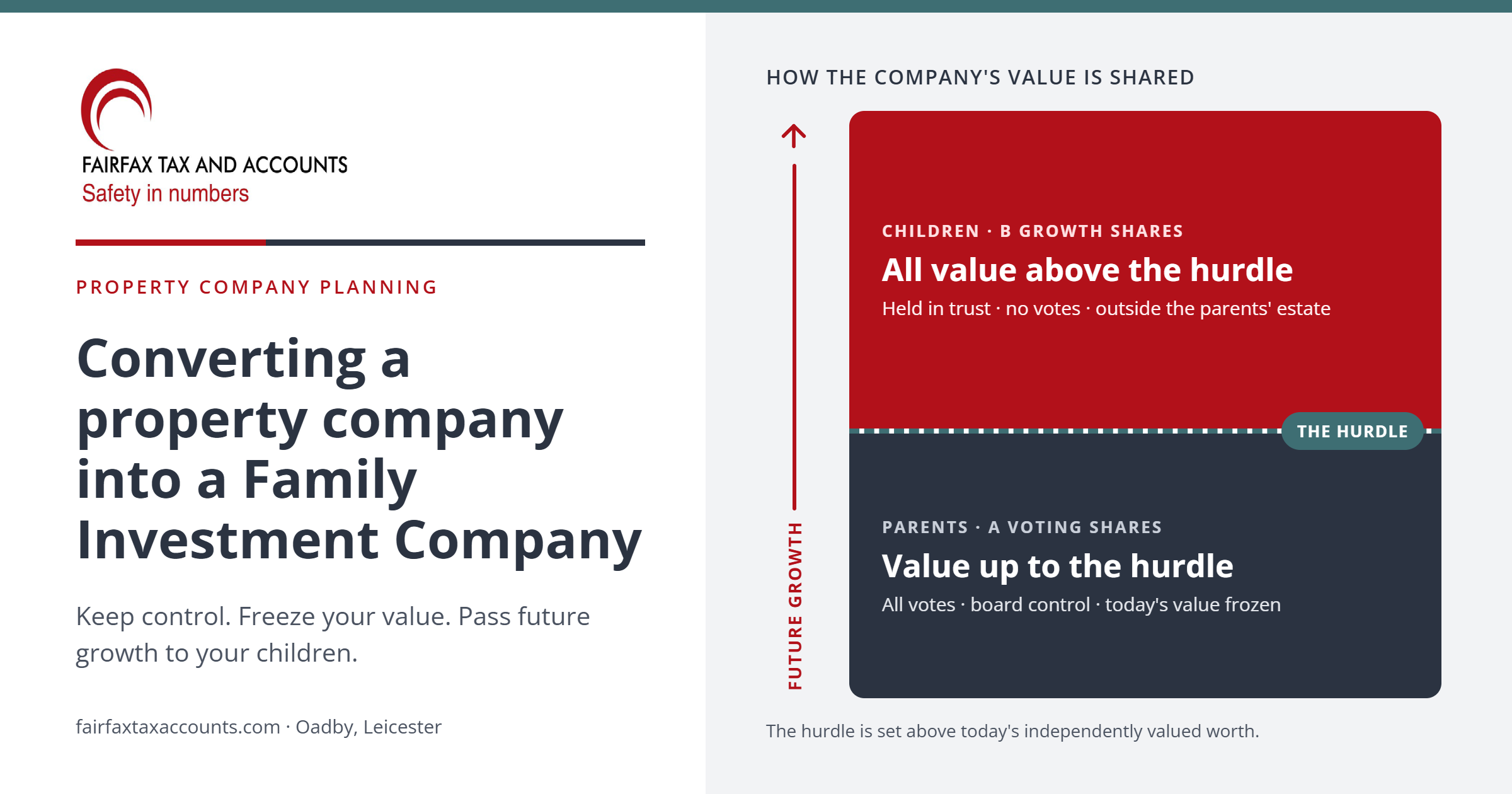
The key concept is the growth-share hurdle: the children only benefit from value above a level set clearly higher than the company’s current worth. That level must be supported by a proper valuation, so that little or no value passes when the shares are issued.
The potential benefit is significant. If a company valued at around £150,000 today grows to £1 million, most of that growth could sit outside the parents’ estates. At a 40% inheritance tax rate, the saving on that growth could run to several hundred thousand pounds.
Can I Convert My Limited Company into a Family Investment Company?
Converting an existing company into a FIC means adopting bespoke articles and, where appropriate, creating separate voting, income and growth share classes. The parents can keep voting control and board control while transferring a defined slice of economic growth to the children.
A typical structure looks like this:
A few design points matter:
- Separate classes per child let dividends be paid to each child independently in future.
- Transfer restrictions in the articles keep shares within the family, including on divorce or bankruptcy.
- Control stays with the parents. Growth shares carry no votes and no right to appoint directors.
Any share arrangement involving family members should also be reviewed against HMRC’s concerns about income diversion. We cover this in more detail in our article on HMRC Spotlight 62 and dividends to family members.
Can I Give Family Investment Company Shares to My Children?
Children under 18 can benefit from growth shares, but the shares are normally held through a trust rather than in the child’s own name.
Family Investment Company Risks: Where These Structures Go Wrong
In our experience, problems rarely come from the idea itself. They come from the detail. The issues we review on every property company conversion include:
- Valuation. If the hurdle is set too close to current value, HMRC may argue that value passed to the children on day one, creating an unexpected tax charge.
- Share rights. Poorly drafted articles can shift value between shareholders without anyone intending it, with inheritance tax and capital gains tax consequences.
- Minor children. Shares for children under 18 need the right holding arrangement, and income paid to them can still be taxed on the parents.
- Mortgage lenders. Many buy-to-let loan agreements restrict changes to a company’s shares or articles. Overlooking this can put the borrowing at risk.
- Tax losses. Companies that have recently refurbished often carry valuable losses, which a poorly planned share issue can restrict.
- Extracting money. How parents draw income from the company after the restructure matters as much as the restructure itself.
- HMRC scrutiny. Family share arrangements are a known focus area for HMRC, as we explain in our article on HMRC Spotlight 62 and dividends to family members.
Each company’s balance sheet, borrowing and family circumstances are different. A structure that suits one landlord can be costly for another.
How Do You Set Up a Family Investment Company from an Existing Company?
Every conversion is tailored, but most follow the same broad path. Typically, it takes a matter of weeks rather than months, with lender approval often the longest step.
- Feasibility review. Is the company investment or trading, what is it worth, and does a FIC suit the family’s goals?
- Lender engagement. Early discussions with mortgage lenders about the proposed changes.
- Independent valuation. Of both the properties and the company’s shares, to support the share structure.
- Structure design. Share classes, rights and the hurdle, together with the right holding arrangement for any minor children.
- Legal documentation. New articles, shareholder resolutions and trust documents, prepared with specialist solicitors.
- Implementation. Issuing the new shares and completing the statutory filings.
- Ongoing compliance. Accounts, tax returns and trust reporting, plus periodic reviews as the family and portfolio change.
Family Investment Company Pros and Cons
Family Investment Company Advice for Landlords in Leicester
Fairfax Tax & Accounts works with landlords, property SPVs and family companies across Leicester and beyond. For FIC conversions, we:
- Review your company’s accounts, borrowing and tax position to confirm whether a conversion makes sense
- Model the potential inheritance tax benefit for your family
- Design the share structure around your goals for control, income and succession
- Coordinate the valuation, legal documentation and lender discussions
- Handle the ongoing accounting and tax compliance once the structure is in place
We work alongside specialist solicitors and valuers, so you have one point of contact from first review to implementation.
You may also find our articles on SPVs and holding companies and incorporation relief after the Autumn Budget 2025 useful, or see our property and landlord accounting services.
Family Investment Company FAQs
Is a family investment company worth it for landlords?
For landlords whose portfolio is expected to grow and who want to pass that growth to their children, it often is. The benefit is greatest where the company’s value is fully exposed to inheritance tax and the family is planning for the long term.
Does a family investment company save inheritance tax?
It can. Growth that builds up on the children’s shares sits outside the parents’ estates. Value the parents keep, including any loans owed to them, remains in their estates.
Family investment company vs trust: which is better?
A FIC avoids the entry and ten-yearly inheritance tax charges that can apply to larger trusts, and lets parents keep control as directors. Trusts can be simpler and cheaper for smaller sums, and the two are often used together.
Can parents keep control of a family investment company?
Yes. Parents usually hold the voting shares and remain directors, while the children’s shares carry economic rights without votes.
How do you take money out of a family investment company?
Common routes include repayment of loans made to the company, dividends and, where appropriate, salary. The right mix depends on each family member’s tax position.
Can a buy-to-let company become a family investment company?
Often, yes. Because the properties stay in the company, a conversion can avoid the Stamp Duty Land Tax and capital gains tax costs of moving property into a new company.
Key Takeaways (Summary)
- Most refurbish-and-let companies are investment companies for tax, whatever their Companies House description, and their value is fully exposed to inheritance tax.
- An existing property company can often become a Family Investment Company through new articles and share classes, without moving the properties.
- A growth-share structure can freeze the parents’ value while future growth accrues to the children, with control remaining with the parents.
- The hurdle is only as strong as the valuation behind it.
- Minor children, lender consent, tax losses and HMRC’s interest in family share arrangements all shape the right structure.
Final Thought
For landlords who have built a portfolio inside a company, a FIC conversion can be one of the most efficient ways to pass future growth to the next generation. Much of the cost of creating a FIC from scratch disappears when the properties never move.
The trade-off is precision. The benefit depends on a defensible valuation, carefully drafted share rights and a structure that reflects genuine long-term family succession rather than short-term tax saving. That is where most of the value, and most of the risk, lies.
If you would like to explore whether a FIC could work for your property company, contact Fairfax Tax & Accounts on 0116 3677424 for an initial review.
This article is general information and not advice for any particular situation. Professional advice should be obtained before restructuring a company’s shares.
Sources
- HCR Law: New inheritance tax rules for family businesses
- Michelmores: Changes to Business Property Relief for business owners
- Fairfax Tax & Accounts: HMRC Spotlight 62 and dividends to family members