Latest blogs from [Company name].
Charity SORP 2026: What Trustees Need to Know (and a Checklist to Get Ready)
By Jitender Kaur ACA, ICAEW member, Fairfax Tax & Accounts | Published 6 November 2026
If your charity's financial year started on or after 1 January 2026, you are already living under the new Charities SORP. You might not have noticed yet. Most charities won't feel the change until year end, when the accounts are drafted and the questions start.
Most charity leaders know the SORP 2026 is here. Far fewer are ready for it. In November 2026 the Charity Finance Group (CFG) surveyed 101 charities and found:
- only 4% said they were fully prepared
- 19% had not started preparing at all
- 23% had not yet looked at the new lease rules
- 27% had not yet looked at the new income rules
- just 14% had agreed a timetable for putting the changes in place
The good news: for most small and medium charities, the changes can be managed with a bit of planning. Below, we cut through the jargon to the changes that will actually affect your accounts, then give you a simple checklist to take to your next trustee meeting.
What Is the Charities SORP, and Why Has It Changed?
The SORP (Statement of Recommended Practice) is the rulebook for how charities across the UK prepare their accounts and trustees' annual report. It sits on top of FRS 102, the main UK accounting standard.
The Financial Reporting Council (FRC) updated FRS 102 with two big changes, and the SORP had to follow:
- a new way of recognising income from contracts and other trading income
- bringing most leases onto the balance sheet
The SORP-making body took the chance to do a wider refresh. It introduced three size-based tiers, beefed up the trustees' report, and tidied up areas like provisions and social investments.
The new SORP was published on 31 October 2025. It replaces the previous SORP (FRS 102), which had been in place since 2015, with later updates.
Who Is Affected and When?
SORP 2026 applies to every charity that prepares accruals accounts (income and expenditure accounts), for financial years starting on or after 1 January 2026. Charities preparing simple receipts and payments accounts are not affected.
When your first SORP 2026 accounts fall
- 31 December year end: year ending 31 December 2026
- 31 March year end: year ending 31 March 2027
- 30 June year end: year ending 30 June 2027
- 31 August year end: year ending 31 August 2027
The changes bite from the first day of that year, and you will need lease and contract information from that date, so the work starts well before the year end.
The three new tiers
How much you have to report now depends on your gross income:
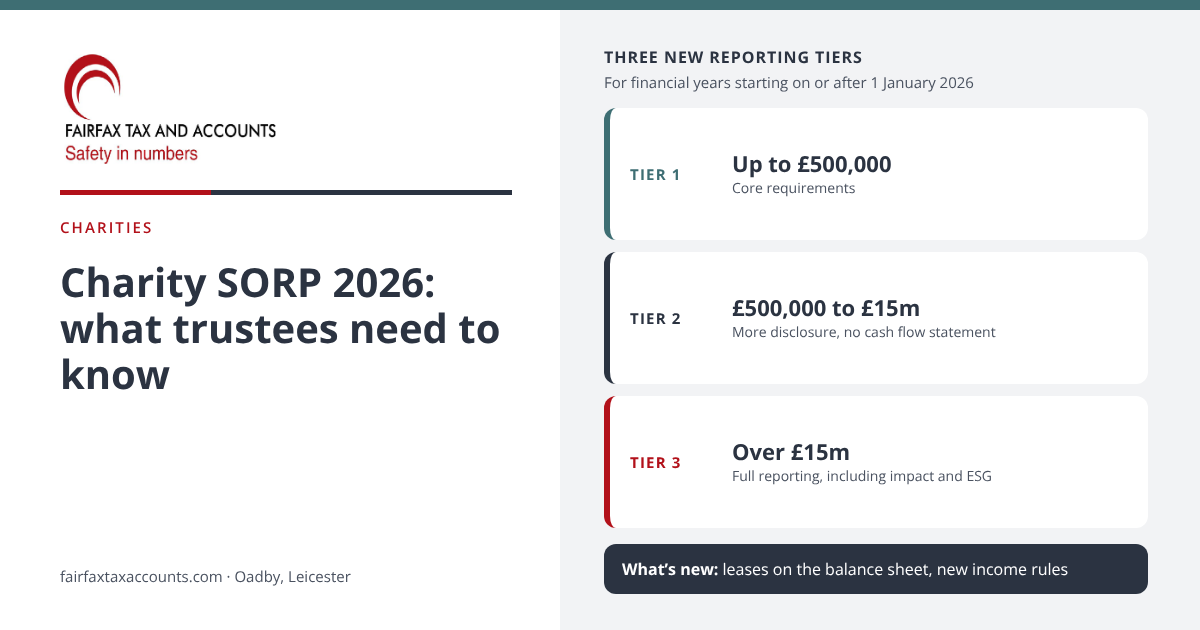
- Tier 1 (up to £500,000): core requirements only
- Tier 2 (£500,000 to £15 million): more disclosure; no cash flow statement needed
- Tier 3 (over £15 million): full requirements, including impact and ESG reporting and a cash flow statement
If your charity is close to a boundary, check which tier you fall into each year. Moving up a tier brings extra disclosures.
Higher thresholds in England and Wales
At the same time, the Charity Commission has raised the income limits for accounts and scrutiny, for financial years ending on or after 30 September 2026:
- Accruals accounts (non-company charities): income over £500,000 (was £250,000)
- Independent examination: income over £40,000 (was £25,000)
- Audit: income over £1.5m, or over £500,000 with assets over £5m (was £1m)
This means some smaller trusts and CIOs may now be able to switch to receipts and payments accounts, or move from an audit to an independent examination. Charitable companies must still prepare accruals accounts whatever their size. In Scotland and Northern Ireland, accruals accounts are still required above £250,000.
The Big Changes in Plain English
1. Leases move onto the balance sheet
This is the change most charities will notice. Until now, rent on a shop, office or minibus lease was simply an expense, paid and charged each month. Under SORP 2026, most leases go on the balance sheet:
- an asset for the right to use the property or equipment
- a liability for the rent you have committed to pay
In the Statement of Financial Activities (SoFA), the rent charge is replaced by depreciation and interest. The total cost over the lease is the same, but more of it falls in the early years.
A quick example: a charity shop on a five-year lease at £20,000 a year could add an asset and a liability of roughly £85,000 to the balance sheet on day one. Nothing has changed in the real world, but the accounts look quite different.
There are simplifications for short leases (12 months or less) and low-value items, which can stay as a simple expense.
Why trustees should care: bigger liabilities can affect loan covenants, reserves calculations and, in some cases, whether your gross assets push you towards an audit.
2. A new model for trading and contract income
Income from contracts and trading is now recognised using a five-step model. It focuses on what you have promised to deliver and when you deliver it. Typical affected income:
- service contracts and service level agreements with local authorities or the NHS
- membership subscriptions that come with benefits
- course fees, events and admission charges
- royalties and long-term contracts
For most simple sales, such as a shop or café, little will change. Where a contract covers several services or runs over a year end, the timing of income can shift between years. Donations, grants and legacies are largely unaffected by the new model.
3. A fuller trustees' annual report
The trustees' report is where your charity tells its story, and SORP 2026 expects more of it:
- clearer reporting of achievements, impact and risks
- more guidance on explaining your reserves and future plans
- new sections on impact reporting and ESG (environmental, social and governance), required for Tier 3 and encouraged for everyone else
- more on volunteers, legacies and pension positions
Think of it as moving from "what we did" to "what difference we made".
4. Other changes worth knowing
- Provisions and contingencies: clearer rules for all charities on when to include future costs and possible liabilities.
- Funding commitments: grants you have promised but not yet included in the accounts must be explained.
- Accrued legacies: material legacy income recognised before the cash arrives needs explaining.
- Social investments: simpler reporting, in line with the Charities Act 2011.
- Cash flow statement: now only needed for Tier 3 charities (income over £15 million), a welcome saving for medium-sized charities.
What It Means for Your Charity
How much work SORP 2026 creates depends less on your size and more on what you lease and how you earn your income. A few typical examples:
- Grant-funded charity working from a donated or owned building: low impact. Look at the trustees' report and reserves wording.
- Community group renting a hall on a short-term basis: low impact. Confirm the lease is 12 months or less.
- Charity with high street shops on multi-year leases: high impact. Build a lease register and check the balance sheet and covenants.
- Care, education or support charity with council or NHS contracts: medium to high impact. Look at contract income timing and leases on vehicles and premises.
- Membership body selling subscriptions with benefits: medium impact. Look at the timing of subscription income.
- Charity near £500,000 or £15m income: medium impact. Check which tier applies and the extra disclosures.
The charities that struggle are rarely the ones with complicated affairs. They are the ones that leave it until the year end, then find the lease documents are in a filing cabinet nobody can find and the contract terms were never written down.
SORP 2026 Readiness Checklist for Trustees and Treasurers
Take this to your next trustee or finance committee meeting. If you can't tick an item, that's your action point.
Step 1: Know where you stand
- We know the start date of our first financial year under SORP 2026
- We know which tier we fall into (up to £500,000, up to £15m, or over £15m)
- We have checked the new thresholds: do we still need accruals accounts, an independent examination or an audit?
- We know which rules apply if we also operate in Scotland or Northern Ireland
Step 2: Leases
- We have a list of every lease: premises, shops, vehicles, photocopiers and other equipment
- We have copies of the lease agreements, with start and end dates, rent and break clauses
- We know which leases are short-term (12 months or less) or low value
- We understand roughly how much will be added to the balance sheet
- We have checked whether any loan covenants or funder conditions refer to our balance sheet
Step 3: Income
- We have listed our income streams and separated donations and grants from contract and trading income
- We have reviewed our main contracts and service agreements for what we promise to deliver, and when
- We know whether any income will move between years under the new rules
- We have considered the effect on our budget and reserves
Step 4: The trustees' annual report
- Our report explains the difference we make, not just what we did
- Our reserves policy and future plans are clear and up to date
- We have decided how much to say about impact, ESG and volunteers (required for Tier 3, encouraged for all)
- We have started gathering the information and case studies we will need
Step 5: People and timetable
- The board has been briefed on SORP 2026
- Our treasurer and finance staff have had training or guidance
- We have checked whether our accounting software or record keeping needs to change
- We have spoken to our independent examiner or auditor
- We have agreed a timetable and who is responsible for each step
Frequently Asked Questions
When does the new Charity SORP 2026 apply?
To financial years starting on or after 1 January 2026. For a charity with a 31 March year end, the first accounts under SORP 2026 will be for the year ending 31 March 2027.
Does SORP 2026 apply to small charities?
It applies to every charity that prepares accruals accounts, whatever its size. Smaller charities fall into Tier 1 and have fewer disclosures. Charities preparing receipts and payments accounts are not affected.
What are the SORP 2026 tiers?
Tier 1 is gross income up to £500,000, Tier 2 is £500,000 to £15 million, and Tier 3 is over £15 million. The larger the charity, the more it must report.
Do charities have to put leases on the balance sheet?
Most leases, yes. Short leases of 12 months or less and low-value items can still be treated as a simple expense.
What are the new charity audit thresholds?
In England and Wales, for financial years ending on or after 30 September 2026, an audit is needed when gross income is over £1.5 million, or over £500,000 with gross assets over £5 million. Independent examination applies above £40,000.
Will SORP 2026 change our reported surplus?
It can. Lease accounting puts more cost in the early years of a lease, and the new income rules can move contract income between years. Your cash position doesn't change, but the figures in your accounts may.
Useful Guidance to Share With Your Trustees
- ICAEW: Charities need to get ready for SORP 2026, a short run-through of the key points, with an audio version to listen to on the go
- Charity Commission: All charities urged to check new rules for accounting for 2026, with links to the guide for each type of charity
- The full Charities SORP 2026
How Fairfax Tax & Accounts Can Help
We prepare accounts for charities and support trustees and treasurers through changes like this. We can help you:
- work out which tier and thresholds apply to you
- build your lease register and calculate the balance sheet effect
- review your contracts and income streams
- update your accounting policies, records and trustees' report
- prepare SORP 2026 accounts ready for your independent examiner or auditor
Contact Fairfax Tax & Accounts on 0116 3677424.
About Fairfax Tax & Accounts
Fairfax Tax & Accounts is an accountancy and tax practice based in Oadby, Leicester. We work with charities, owner-managed businesses, landlords and professionals, providing accounts, tax, VAT and payroll services with a personal, practical approach. Whether you are a trustee getting to grips with SORP 2026 or a treasurer who wants a second pair of eyes on the accounts, we explain things clearly and help you get it right first time.
This article is general information based on the position at November 2026. It is not advice for your charity's circumstances. Please speak to your accountant, independent examiner or auditor.
Sources
- ICAEW: Charities need to get ready for SORP 2026
- Charity Commission: All charities urged to check new rules for accounting for 2026
- Charity Commission: Shift to more proportionate accounting regime for UK charities
- Civil Society: One in five charities yet to start preparing for the new SORP (CFG survey)
- Azets: The Charities SORP 2026, a summary
- PKF Francis Clark: Charities SORP 2026, five questions to ask now